

Every August the same thing happens. The week before term, a parent arrives with a child who has been squinting at the television all summer, and they need glasses by Monday.
We can nearly always help. But a rushed exam and a rushed pair of glasses is not what you want for a child about to spend six hours a day looking at a whiteboard.
So this is the version of the advice we would rather give you in July.
Why Four to Six Weeks Before Term, Not the Week Before
Almost everything that happens in a classroom arrives through the eyes, the board, the book, the screen. A child who cannot see it clearly falls behind quietly, because they have no idea other people see differently.
The window exists for a practical reason. Lenses have to be made, the frame fitted and adjusted, and a first pair needs a week or two of wearing before a child is expected to concentrate through them. And if the examination finds something needing a second visit, a lazy eye, or early myopia worth managing, you want that conversation before school starts, not in the middle of week three.
The Checklist
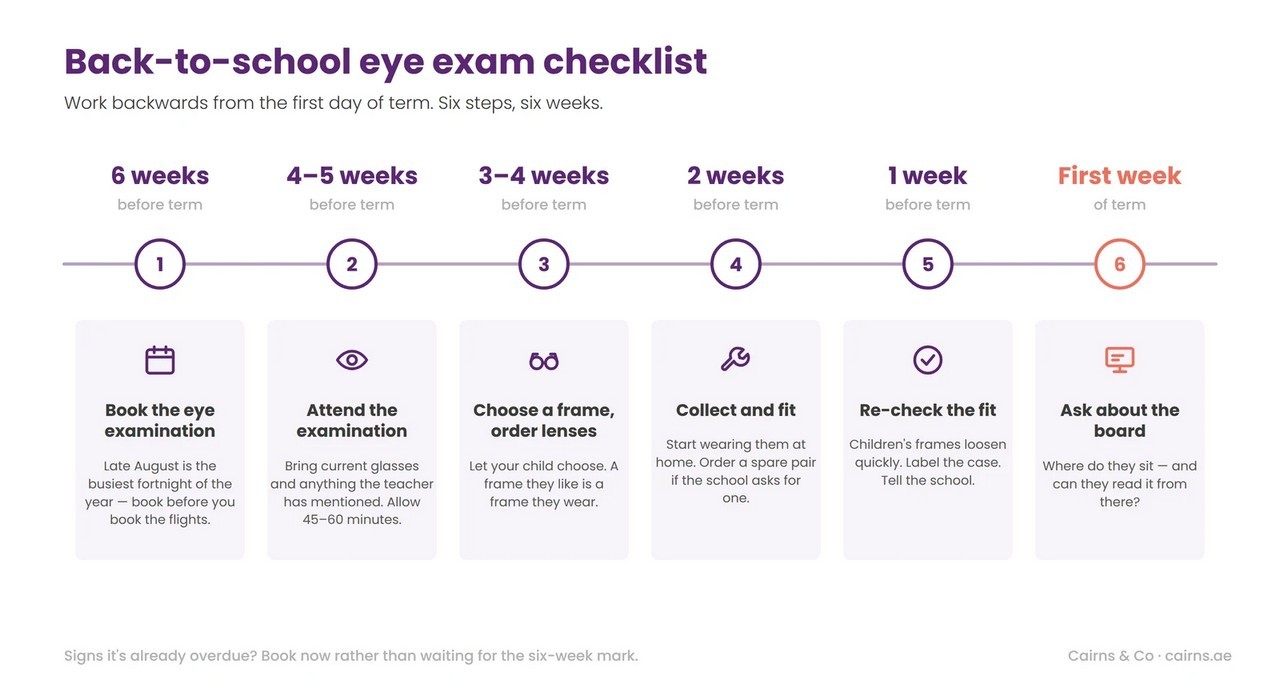
Work backwards from the first day of term.
- Six weeks before: book the examination. Late July and the last two weeks of August are our busiest fortnight of the year — book the appointment before you book the flights home.
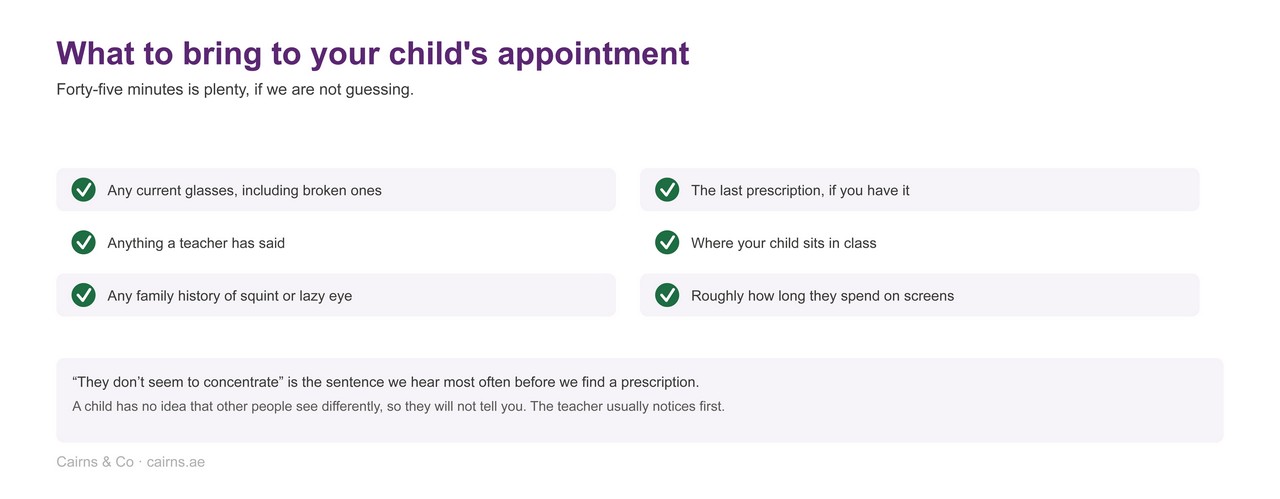
- Four to five weeks before: attend. Bring any current glasses, the last prescription, and anything a teacher has mentioned. Allow 45 to 60 minutes.
- Three to four weeks before: if glasses are needed, choose the frame and order the lenses. Let your child choose — a frame they like is a frame they wear. We measure the frame to the child, not the other way round; here is why frame measurements matter.
- Two weeks before: collect, fit, adjust, and start wearing them at home. Order the spare pair now if the school asks for one.
- One week before: check the fit again after a week of wear. Children’s frames loosen quickly. Label the case. Tell the school about the prescription.
- First week of term: ask where your child sits and whether they can read the board from there. If the answer is “sort of”, come back — the fix is usually a seat, not a new prescription.
What a Proper Back-to-School Eye Exam Includes
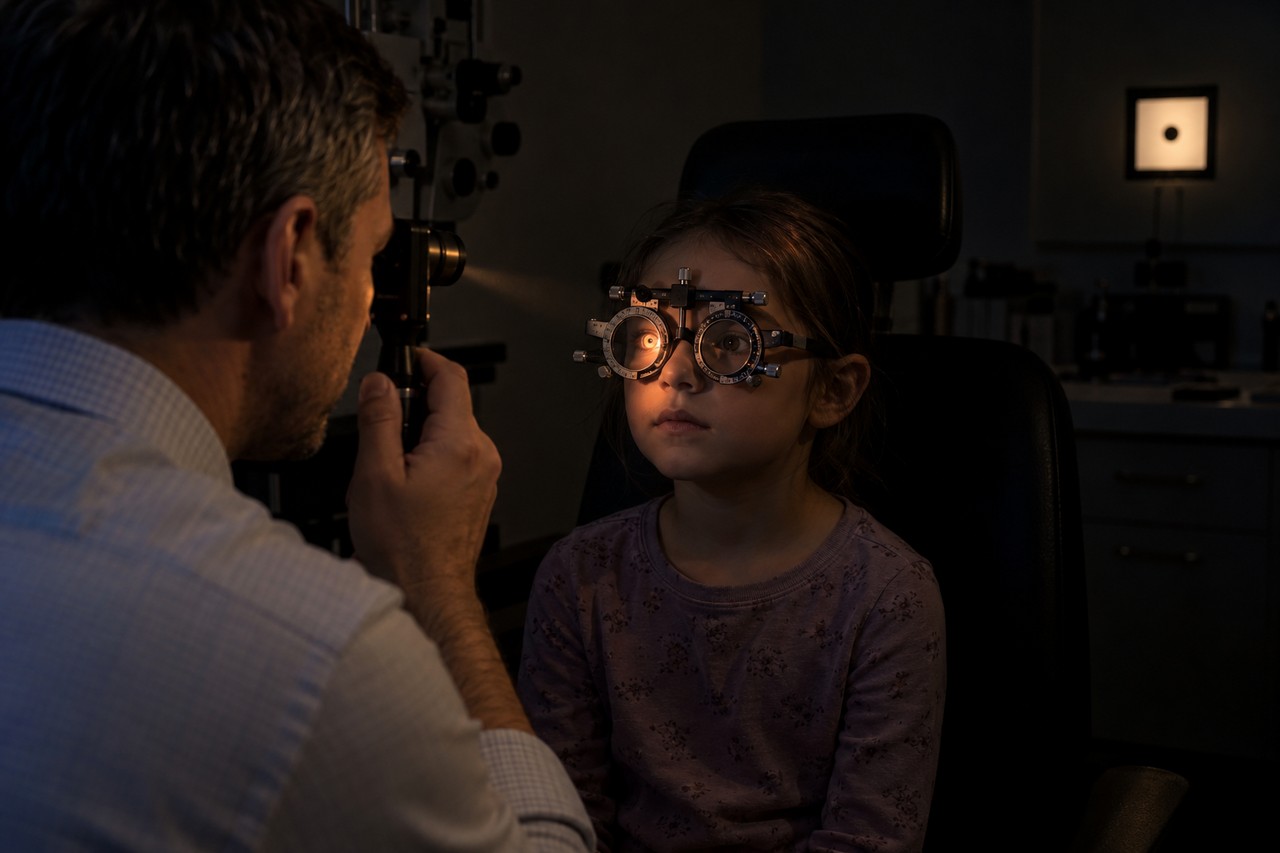
A children’s eye examination here covers five areas.
Refraction
The measurement of the prescription: short-sighted, long-sighted or astigmatic, and by how much.
Children’s eyes compensate very well, so a young child can mask a long-sighted prescription almost entirely. We measure it with retinoscopy and carefully controlled fixation rather than relying on what the child tells us.
We do not use dilating or focus-relaxing drops. Where a drop-assisted refraction is genuinely needed, we arrange it with a partner ophthalmologist.
Eye teaming and focusing
Two eyes have to point at the same place, focus at the same distance, and switch from board to desk dozens of times an hour.
We test how well they work together, how quickly they change focus, and whether they can hold a near focus for the length of a page. Weakness here is one of the commonest reasons a child with “perfect vision” still avoids reading.
Eye health
We examine the front and back of the eye at the slit lamp, a microscope with a fine, bright beam, using a small hand-held lens to see the retina, macula and optic nerve. It is quick and painless, and it is something a school screening cannot do.
We do not photograph the retina, and we do not use dilating drops. Where imaging is needed, we refer to a partner ophthalmologist.
The conditions that affect classroom work
Astigmatism blurs and doubles letters at every distance and is easy to miss on a distance chart. Early myopia is common enough in Dubai that we look for it specifically in every school-age child.
We also check for amblyopia, or lazy eye, which is very treatable before seven and much harder afterwards. We also screen for colour vision deficiency, which a teacher needs to know about.
A conversation about screens
Not a lecture. We ask how much time your child spends on close work and screens, indoors and outdoors, because the balance between them is one of the few things that genuinely changes their risk of becoming short-sighted.
Two hours a day outside is the number that keeps coming up in the research.
Why the School Screening Is Not the Same Thing
Most Dubai schools screen vision at intake and at intervals after that, and it is a good thing they do.
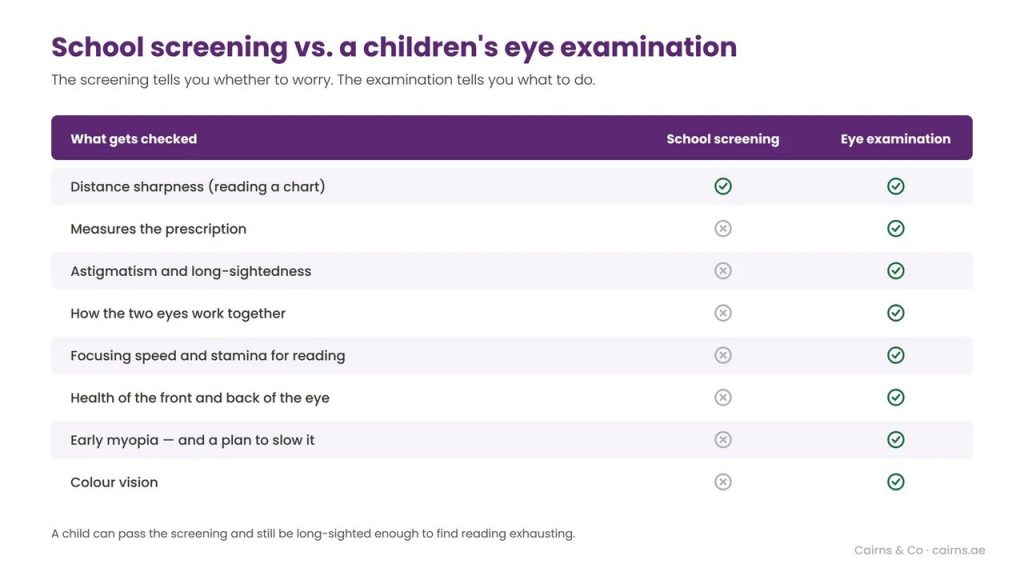
But a screening is designed to catch children who clearly cannot see the chart. It does not measure a prescription, test how the eyes work together, or look inside the eye.
A child can pass the screening and still be long-sighted enough to find reading exhausting. The screening tells you whether to worry; the examination tells you what to do.
Signs the Exam Is Already Overdue
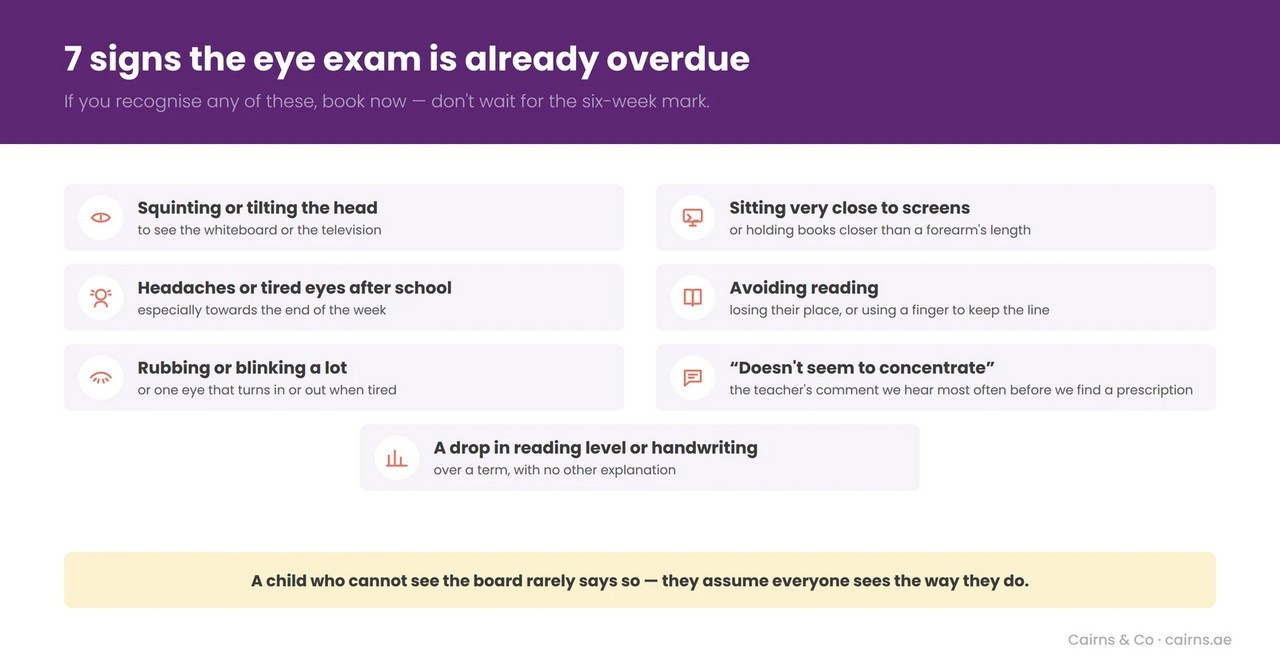
If you recognise any of these, book now rather than waiting for the six-week mark.
- Squinting, screwing up the eyes or tilting the head to see the whiteboard or the television
- Sitting very close to screens, or holding books closer than a forearm’s length
- Headaches or tired eyes after school, especially towards the end of the week
- Avoiding reading, losing their place, or using a finger to keep the line
- Rubbing the eyes, blinking a lot, or one eye turning in or out when tired
- A teacher’s comment that they “don’t seem to concentrate” — the words we hear most often before we find a prescription
For the full list and what each sign might mean, read our guide to early detection of vision problems in children.
A Practical Note for Dubai Parents
Appointment availability. The last two weeks of August are the hardest time of year to get a children’s appointment anywhere in Dubai, including with us. Early July, or the first week after the October half-term, are far easier. We are open six days a week, and you can book online in under a minute.
Turnaround for glasses. Standard single-vision lenses are usually ready within 7–10 days. High prescriptions, myopia-control lenses and tinted or photochromic lenses take two to three weeks.
If contact lenses are being considered, a contact lens fitting involves a trial period, and an Ortho-K fitting, overnight lenses giving clear daytime vision without glasses, takes four to six weeks from first visit to settled wear. Start those in June, not August.
Book Before the Rush
If your child has not had a full eye examination in the last twelve months, the best time to book is now. Book a children’s eye examination at Cairns & Co, Dubai, or read what to expect before you come. Unfamiliar with a term here? The optical glossary explains it in plain English.
Frequently Asked Questions
Q. How often should a school-age child have an eye examination?
A. Every year, unless we advise otherwise. Children's eyes change quickly, and a prescription that was right in September can be out by the following summer. Children with myopia, a lazy eye or a family history of eye conditions are usually seen more often.
Q. My child passed the school screening. Do they still need an exam?
A. Yes. A screening checks distance sharpness only. It cannot measure a prescription, test how the eyes work together, or look at the health of the eye. Passing it is reassuring, not conclusive.
Q. How long does a child's eye examination take?
A. Allow 45 to 60 minutes. That covers the history, vision and refraction, eye teaming and focusing, eye health, and a conversation about screens and reading. We do not use dilating drops, so there is nothing to wait for and no blurred vision afterwards; your child can go straight back to school or on to an activity.
Q. What if my child needs glasses and term starts next week?
A. Book anyway. We can usually have single-vision glasses ready within days, and a short delay is far better than a term of not seeing the board. Tell us the first day of school when you book, and we will do what we can.