

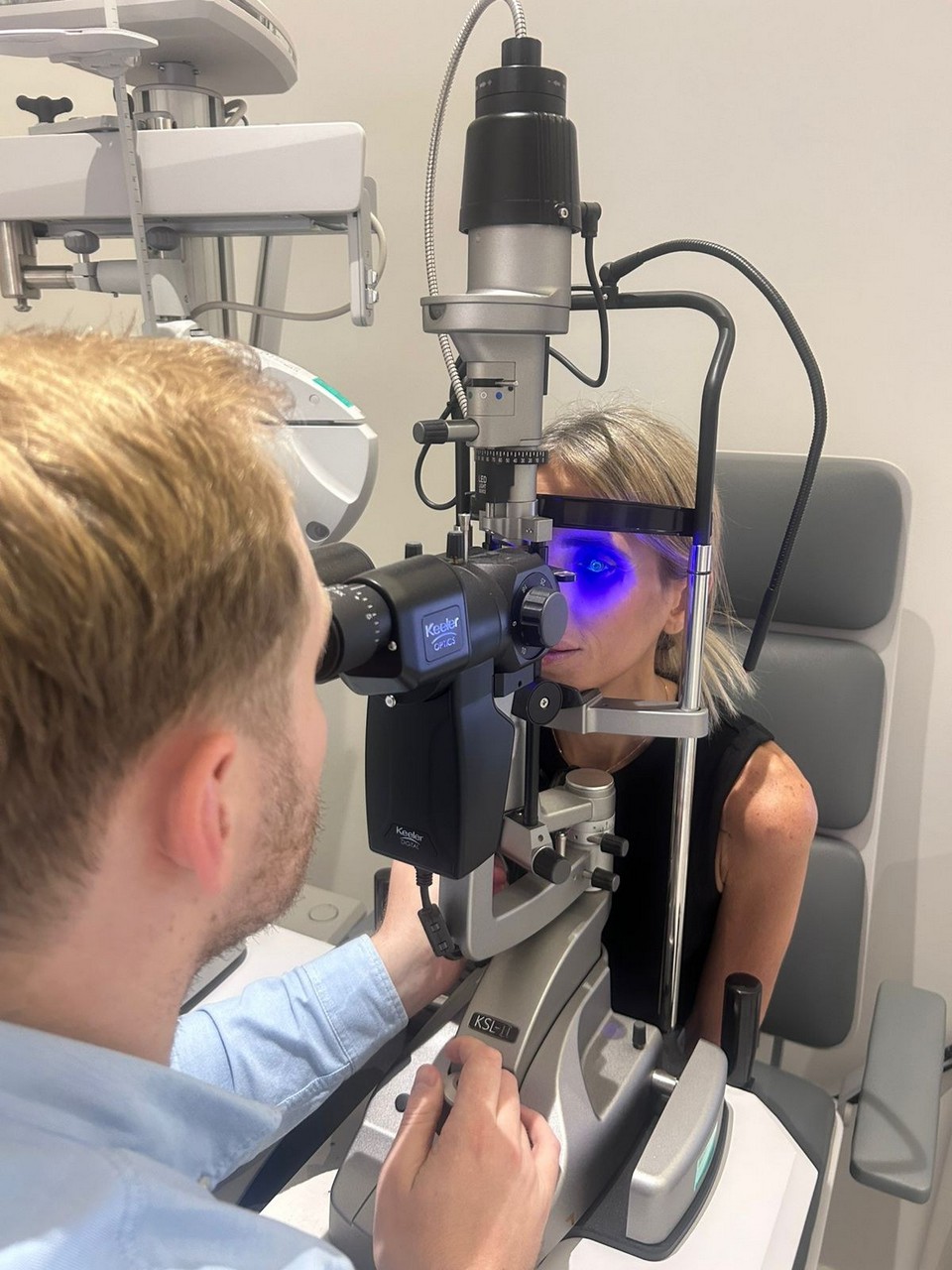
Glaucoma is the second leading cause of irreversible blindness worldwide, and roughly half the people who have it do not know.
That second figure is the whole problem.
Glaucoma does not hurt. It does not blur your vision. It quietly removes the outer edges of your sight, so slowly that your brain fills in the gaps and your other eye covers what is missing.
By the time anyone notices, a great deal of optic nerve has gone. Unlike a cataract, it does not come back.
What Is Glaucoma?
Glaucoma is damage to the optic nerve, the cable of roughly a million fibres carrying images from the retina to the brain. As fibres die, matching patches of your visual field go with them.
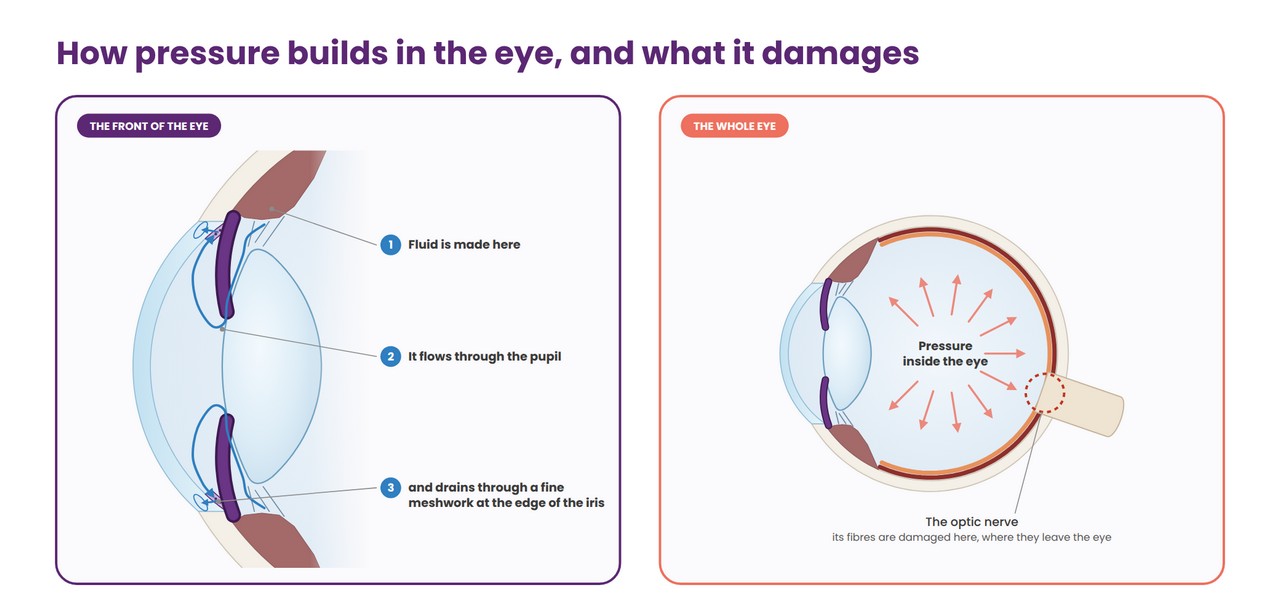
Raised pressure inside the eye is the main risk factor, and lowering it is the main treatment. But glaucoma is a disease of the nerve, not of the pressure.
That distinction is not academic. It is the reason a pressure test on its own is not a glaucoma test.
What raises the pressure
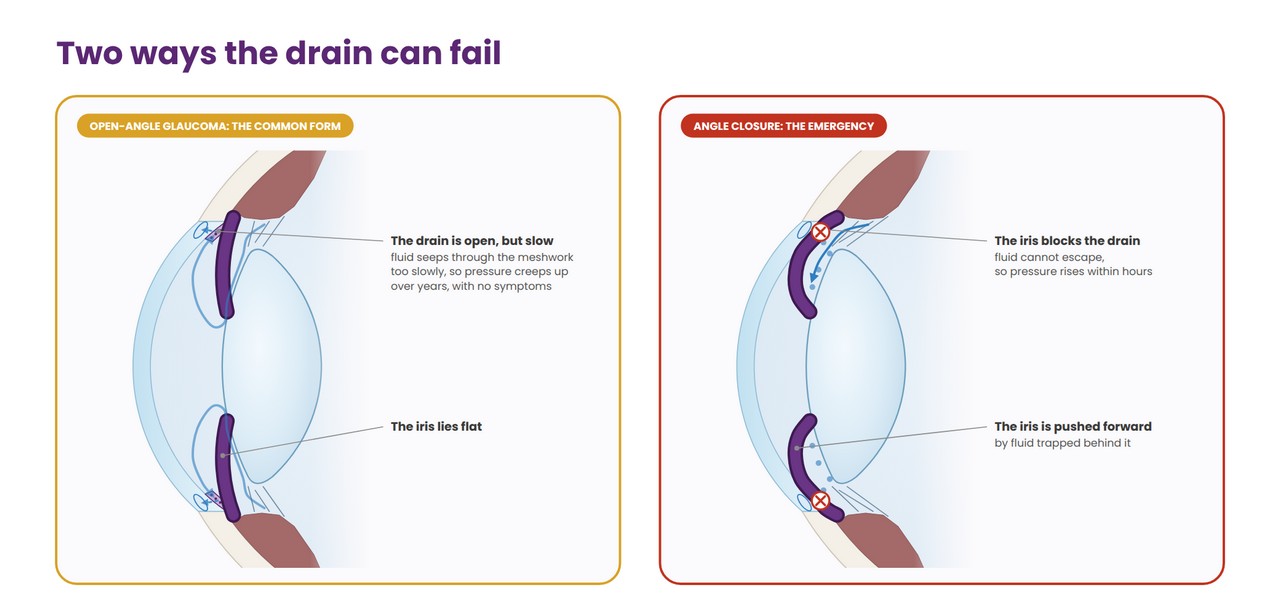
The eye continuously makes a clear fluid and drains it through a meshwork near the edge of the iris. If drainage slows, pressure builds in the common form, gradually, over years, with no sensation at all.
Why a normal pressure is not the all-clear
A substantial proportion of people with glaucoma have pressures in the normal range throughout. Their optic nerves are simply more susceptible.
If pressure is all that gets measured, those people are reassured and sent home, repeatedly, while the damage continues.
Glaucoma Screening and Eye Tests in Dubai
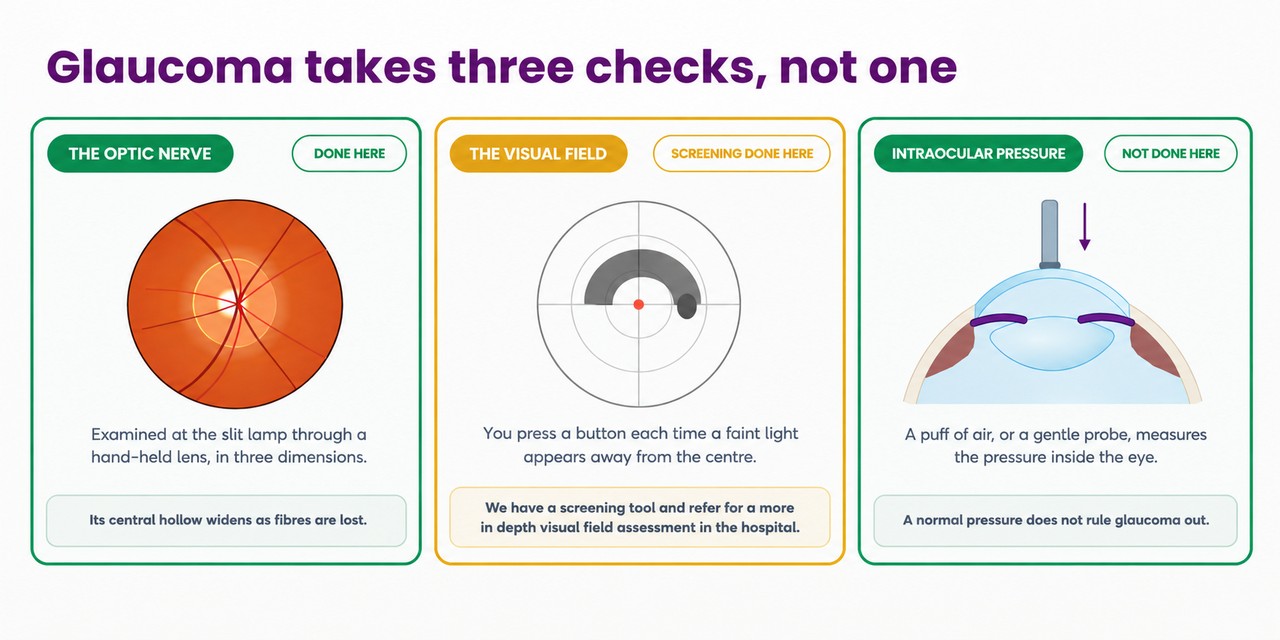
Finding glaucoma takes three things. We do two of them here and arrange the third. It is worth saying which is which.
Optic Nerve Examination for Glaucoma
The most informative. The nerve head has a natural hollow at its centre, and as fibres are lost, that hollow widens. Asymmetry between the two eyes, a notch in the rim, or a small haemorrhage at the disc margin are all things we actively look for.
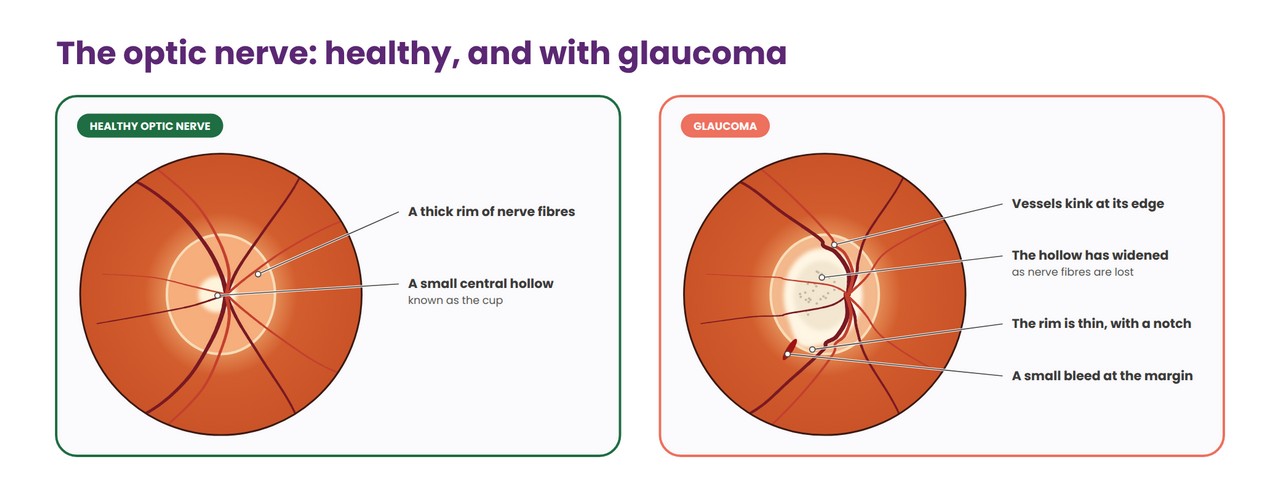
We examine it at the slit lamp with a hand-held condensing lens. That gives a magnified, genuinely three-dimensional view, and depth is exactly what you need when judging a cup.
We do not photograph it, and we do not have OCT. Where an objective, repeatable record is needed to track change over time, that is a reason to refer rather than something to gloss over.
The visual field — screening
You look at a central target and press a button each time a faint light appears somewhere in your peripheral vision. It is the only way to find the gaps your brain has been hiding from you.
Early loss is an arc or a small island rather than a neat dark edge. People are frequently astonished. They were sure they could see perfectly.
We have a visual field screener at Cairns & Co. Where your visual fields or your optic nerves raise a question, we arrange eye pressure checks, enhanced visual field assessment and OCT if it is needed with a partner ophthalmologist, and we stay involved in what comes back.
We would rather tell you that plainly than imply a check we cannot carry out.
How Glaucoma Affects Your Vision
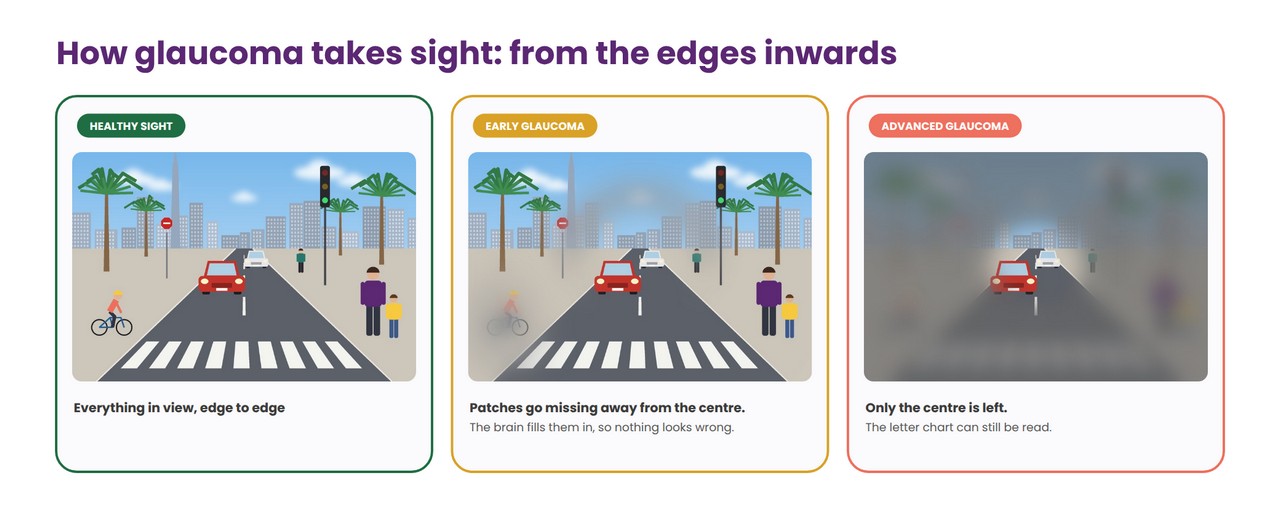
Glaucoma works inwards from the periphery. Central vision, reading, faces, the letters on a chart are all usually the last to go.
That is why someone can have advanced glaucoma and still read the bottom line of the test chart.
Peripheral vision is what you use for stairs, kerbs, doorways and driving. Its loss shows up as clumsiness, missed steps and trouble driving, long before anyone connects it to their eyes.
Who Is at Risk of Glaucoma?
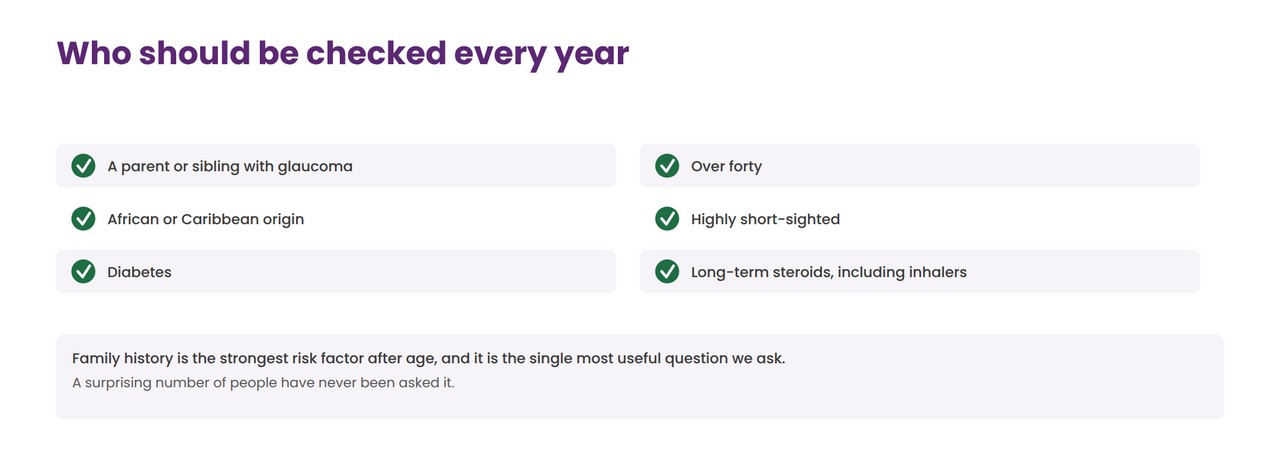
Family history is the strongest risk factor after age. A parent or sibling with glaucoma raises your own risk several-fold.
It is the single most useful question we ask, and a surprising number of people have never been asked it.
Risk climbs steadily from around forty and sharply after sixty.
Ethnicity matters too. People of African and Caribbean origin have a substantially higher risk of the common open-angle type, often earlier and faster-moving. People of East and South Asian origin have a higher risk of the angle-closure type. In a population as mixed as Dubai’s, that is worth saying rather than glossing over.
High short-sightedness raises the risk of open-angle glaucoma; significant long-sightedness raises the risk of angle closure. Both are reasons for a careful look rather than a quick refraction.
So do diabetes, long-term steroid use, inhalers and a previous eye injury.
Symptoms of Acute Angle-Closure Glaucoma
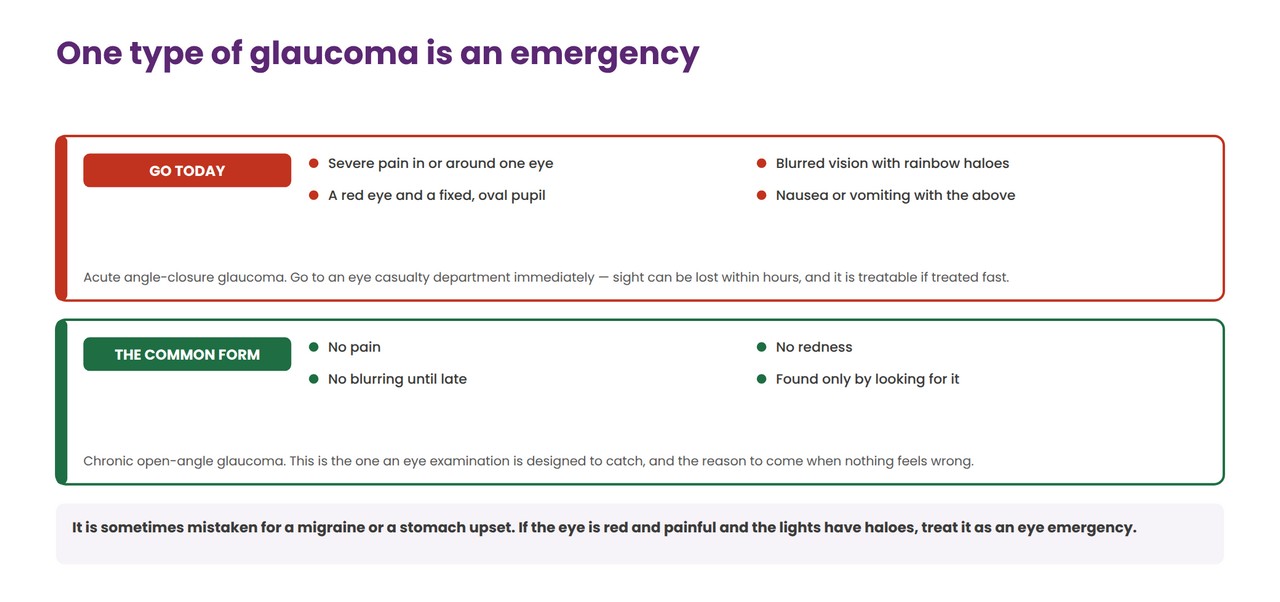
Everything above concerns chronic open-angle glaucoma, which is silent. There is a much rarer form, acute angle-closure glaucoma, which is the opposite.
It causes severe pain in or around the eye, a red eye, blurred vision with rainbow haloes around lights, a fixed and oval-looking pupil, and often nausea and vomiting, enough that it is sometimes mistaken for a migraine or a stomach upset.
If that combination happens, go to an eye casualty department immediately. Sight can be lost within hours, and it is treatable if treated fast.
Treatment, and What It Can and Cannot Do
Treatment lowers the pressure inside the eye. That is the only intervention proven to slow glaucoma, and it works well.
Most people use drops, usually once a day. Laser treatment to improve drainage is common and effective. Surgery is reserved for what the other two cannot control.
All of it is prescribed and performed by an ophthalmologist. Our job is finding it, referring promptly, and looking after the rest of your eye care alongside.
What treatment cannot do is restore what has gone. Every field of vision saved is one that had not yet been damaged when the diagnosis was made. That is the entire argument for having your eyes examined when nothing is wrong.
The one thing that undermines treatment is stopping the drops. Nothing gets sharper and nothing feels better, so people conclude they are not working. They are working. The absence of change is the point.
How Often Should You Have a Glaucoma Test?
Every two years for most adults under forty with no risk factors. Annually from age 40.
Annually at any age if you have a family history, are of African or Caribbean origin, have diabetes, are highly short-sighted or take long-term steroids. And as often as your specialist asks, if you are already diagnosed.
A full eye examination here includes screening of the visual field and a three-dimensional assessment of the optic nerve as standard. They are not an optional extra.
If either of them raises a question, we arrange the enhanced visual fields, pressure assessment and any imaging with a partner ophthalmologist rather than waiting to see what happens by your next visit.
Book an Eye Examination in Dubai
If you are over forty, or anyone in your family has glaucoma, and it has been more than a year, this is the reason to book. Book an appointment with our UK-trained optometrists, read more about glaucoma screening and what your examination involves, or look up a term in the optical glossary.
Frequently Asked Questions
Q. Does glaucoma have any early symptoms?
A. Chronic open-angle glaucoma has no symptoms at all until a significant amount of vision has been lost. No pain, no blurring. That is exactly why it has to be looked for rather than waited for.
Q. If my eye pressure is normal, am I in the clear?
A. No. A substantial proportion of glaucoma occurs at normal pressure. Pressure is one of three checks; the optic nerve examination and the visual field test complete the picture.
Q. Do you test visual fields at Cairns & Co?
A. We do a screening of the visual fields and assess the optic nerve at the slit lamp with a hand-held condensing lens, which gives a three-dimensional view. Where the examination raises a question, we arrange enhanced visual field testing and OCT where it is needed with a partner ophthalmologist, and we stay involved in the result.
Q. Can glaucoma be cured?
A. No, but it can be controlled very effectively. Lowering the pressure slows or halts further damage. Sight already lost cannot be recovered, which is why early detection is everything.
Q. My father has glaucoma. When should I start being checked?
A. Annually, from around forty, earlier if your optometrist finds anything that warrants it. A first-degree relative raises your risk several-fold, and it is the most important thing to tell us at your appointment.
Q. Does Cairns & Co have OCT for glaucoma monitoring?
A. No. We assess the optic nerve at the slit lamp with a hand-held condensing lens, which gives a three-dimensional view. OCT gives an objective, repeatable measurement for monitoring change; where that is needed we refer to a partner ophthalmologist who has it.
Q. Will I go blind if I have glaucoma?
A. Most people diagnosed and treated in good time keep useful vision for life. Those who lose their sight to glaucoma are overwhelmingly the ones diagnosed late, or who stopped their treatment.