


When a child’s prescription goes up again, most parents are told the same thing: they have grown, here are stronger lenses, see you next year.
That describes the problem. It does not respond to it.
Short-sightedness in a growing child is a process, not a fixed fact. It can be slowed, and the window in which you can slow it closes when the child stops growing.
What Is Myopia (Short-Sightedness) in Children?
Myopia is usually not a problem with the lens in front of the eye. It is a problem with the length of the eye itself.

In a myopic eye, the eyeball has grown slightly too long from front to back. Light comes to a focus just in front of the retina, so distance vision blurs.
Glasses move that focal point back onto the retina. They correct the symptom perfectly – and do nothing about the length of the eye.
So the question that matters is not “how strong are the glasses this year”. It is “how fast is this changing, and can we slow it”.
Why Is Early Myopia Management Important for Children?
Parents are often reassured that myopia is common and easily corrected. Both are true. Neither is the whole picture.
An eye that has grown long is a structurally stretched eye, and stretching carries lifetime risk. High myopia substantially raises the risk of retinal detachment, glaucoma and myopic macular degeneration in later life. The risk rises with every dioptre.
So the aim is not to make a child see better today – glasses already do that. It is to finish growth at a lower prescription than they otherwise would have, and therefore at lower lifetime risk.
A child finishing at −3.00 rather than −6.00 is a meaningfully different eye.
Which Children Are Most at Risk of Progressive Myopia?
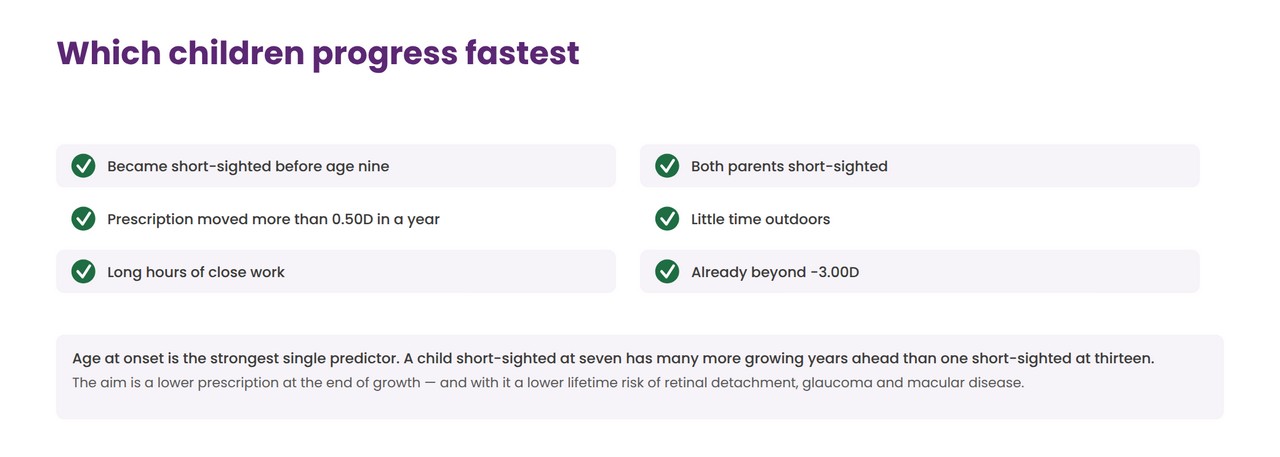
Age at onset is the strongest single predictor.
A child who becomes short-sighted at seven has many more growing years ahead than one who becomes short-sighted at thirteen, and will usually finish at a much higher prescription. Early onset is the clearest reason to act rather than wait.
A prescription that has moved more than about half a dioptre in a year is a prescription that is likely to keep moving. That is the trigger for a conversation.
What Are the Four Main Myopia Control Options for Children?

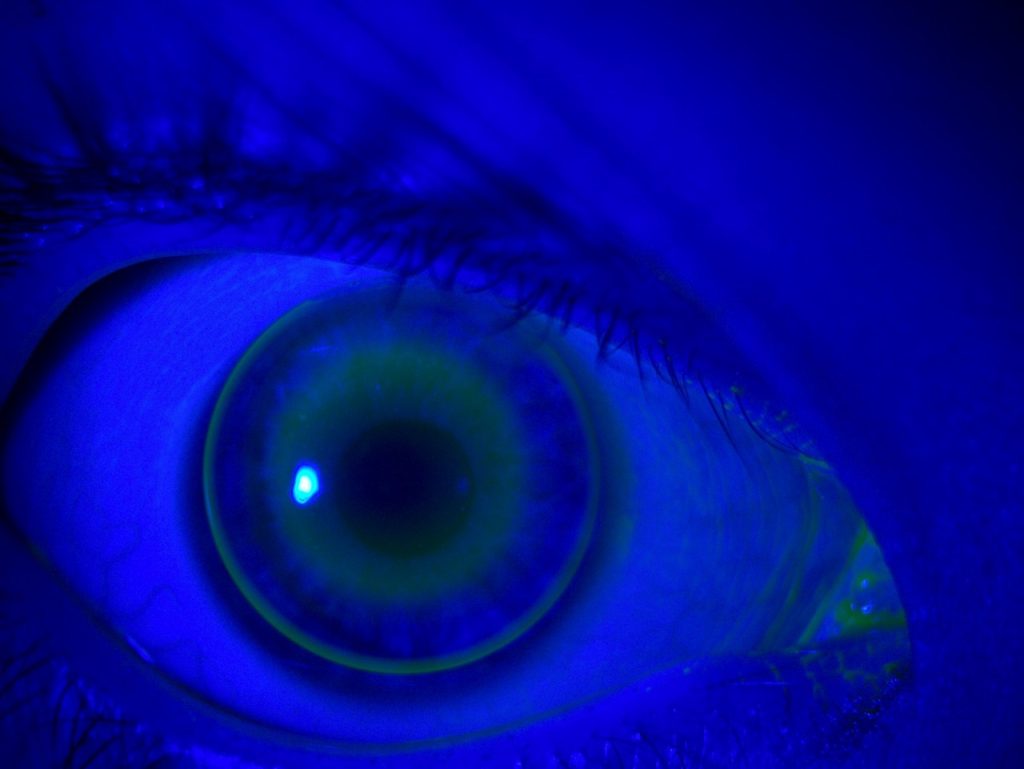
Orthokeratology
Ortho-k lenses are rigid lenses worn overnight that gently reshape the front of the cornea. Vision is clear all day with no glasses and no lenses.
For sport, swimming and self-consciousness at school, nothing else comes close. It needs careful fitting and disciplined nightly hygiene.
Dual-focus soft contact lenses
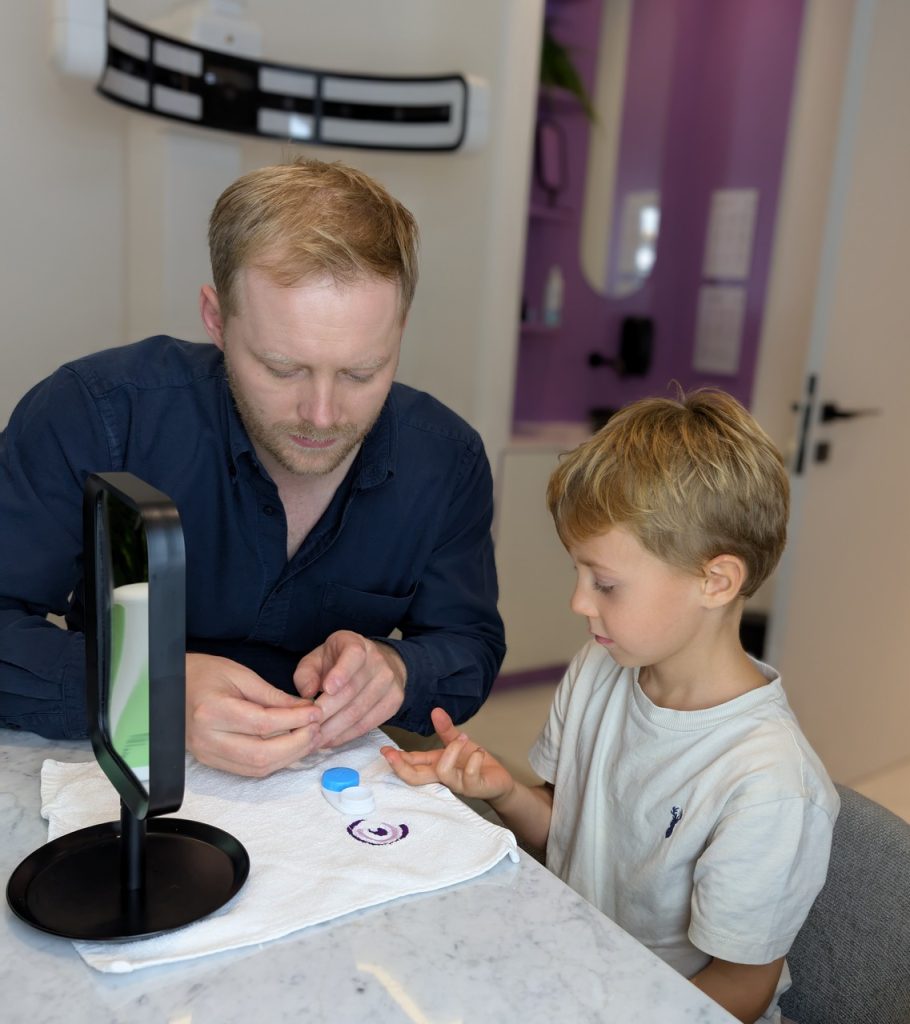
Daily disposables designed for myopia control. Worn in the day, thrown away at night – no cleaning, no storage, and most of the infection risk removed.
These lenses however are currently not available in the region.
Myopia control spectacle lenses
Ordinary-looking glasses with a specially designed lens surface.
For a child not ready for contact lenses, these are a genuine option rather than a consolation prize – the published results are respectable and the child does nothing differently.

Low-dose atropine
A very dilute drop at bedtime, with good evidence behind it, often combined with one of the optical approaches.
It is a prescription medicine, so it is prescribed and supervised by a partner ophthalmologist. We coordinate the referral.
How Can Parents Help Slow Myopia Progression at Home?
Worth being straight about, because the marketing in this field runs ahead of the science.
These approaches slow progression on average – commonly reported as somewhere between a third and a half, depending on method and study. They do not stop it. They do not reverse what has happened.
And the response varies a great deal between children. Some respond very well, some modestly, a few barely at all.
That is precisely why measurement matters. We measure the prescription carefully at every visit and track how fast it is moving, so you can see what is happening in your child’s eyes rather than relying on an average from a trial. If a method is not working, we change it.
A word on measuring eye length
Some practices measure the physical length of the eye with an optical biometer. We do not have one, and we would rather say so than let the word “measurement” do work it has not earned.
A prescription tracked consistently, by the same people, with the same technique, answers the practical question well: is this still moving, and how fast. That is what decides whether to start, continue or change an approach.
How Can Parents Help Slow Myopia Progression at Home?
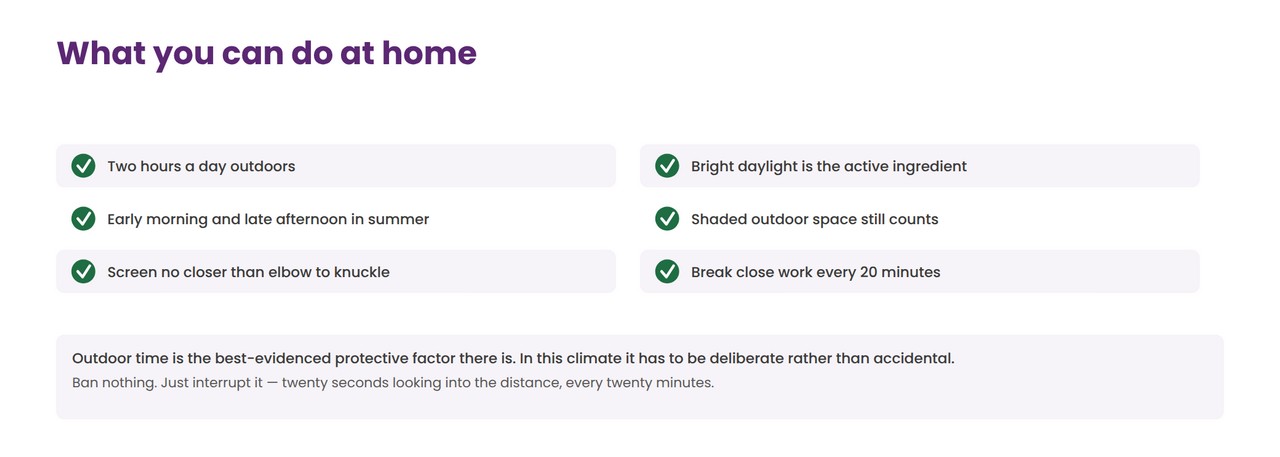
Get them outside. Two hours a day of outdoor light is the single best-evidenced thing you can do – and in Dubai that means being deliberate about it.
Watch the working distance. Reading or a screen should be no closer than elbow to knuckle, and close work should be broken every twenty minutes.
Ban nothing. Just interrupt it.
Book a Myopia Assessment for Your Child in Dubai
If your child’s prescription has gone up twice in two years, it is worth a proper conversation rather than another pair of stronger lenses. Book an appointment, read more about myopia management and orthokeratology, or see what a children’s eye examination involves. Unfamiliar with a term? Our optical glossary explains it in plain English.
Frequently Asked Questions
At what age should myopia management start?
As soon as a child is found to be short-sighted and is still growing - commonly from six or seven. The earlier myopia appears, the more years it has to progress.
Will my child's eyesight get better?
No. Myopia management slows the rate at which short-sightedness increases; it does not reverse it. The aim is a lower prescription at the end of growth.
How do you measure whether it is working?
By tracking the prescription carefully at every visit and comparing the rate of change with what came before. We do not have an optical biometer, so we do not measure the physical length of the eye - a consistently measured refraction answers the practical question of whether it is still moving, and how fast.
Are contact lenses safe for a child?
Yes, when fitted and supervised properly. Daily disposables in particular carry a low risk because there is no cleaning or storage. Children often handle lenses more reliably than teenagers.
Does screen time cause short-sightedness?
Screens are part of a wider picture rather than a single cause. The strongest evidence is on the other side - children who spend more time outdoors in daylight are less likely to become short-sighted.
Do normal glasses make myopia worse?
No. This is a persistent myth. Ordinary glasses have no effect, good or bad, on how quickly the eye grows.
How long does myopia management continue?
Usually until the prescription has been stable in the late teens or early twenties. Stopping too early can be followed by catch-up progression.