


Almost everyone who wears varifocals for the first time has the same thought on day one: this doesn’t feel right.
That reaction is normal, and it is temporary for the great majority of people. It helps a lot to know in advance what you are feeling, why the lens behaves that way, and when the odd sensation is simply adaptation rather than a sign that something is wrong.
Here is what the first fortnight usually looks like, and how to tell the difference.
What a Varifocal Lens Actually Does
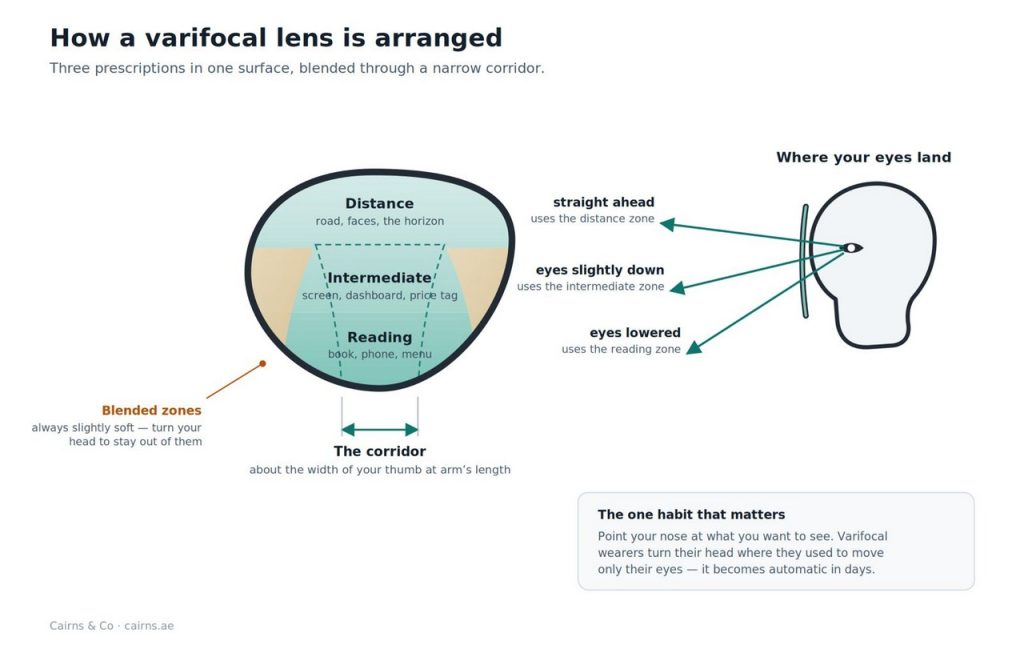
A varifocal, also called a progressive lens, carries more than one prescription in a single lens, with no visible line between them. It is the standard answer to presbyopia, the gradual loss of near focus that begins for most people in their forties.
Three zones sit in the lens, blending into one another:
- The top is set for distance — road signs, faces across a room, the sea.
- The middle is set for arm’s length — a computer screen, a dashboard, a price tag.
- The bottom is set for reading — a book, a phone, a menu.
Between the top and the bottom runs a narrow channel of gradually changing power, called the corridor. It is roughly the width of your thumb held at arm’s length.
That narrowness is the part nobody warns you about. Either side of the corridor, towards the lower corners of the lens, the optics have to blend, and those areas will always look slightly soft or swimmy.
This is not a fault, and it is not a cheap lens. It is a physical consequence of packing several prescriptions into one surface. Better lens designs make those zones smaller and push them further out of the way. No design removes them.
How small they are is largely down to the design. The varifocals we fit as standard are ZEISS ClearMind, and there is a section on why further down.
What the First Two Weeks Usually Feel Like
Days one to three
This is the strangest stretch. The floor may appear to curve upwards slightly. Door frames can seem to bend as you turn your head. Stairs and kerbs feel unreliable, because you are looking down through the reading zone at something that is actually several feet away.
Some people also feel mildly queasy for the first day or two.
The first week
The swimming sensation settles. You start finding the reading zone without hunting for it. Most people notice the change somewhere between day four and day seven, usually as an absence, when they realise they have stopped thinking about their glasses.
By two weeks
Adaptation is normally complete. Head movement has become automatic, stairs are no longer an event, and switching between a screen and a phone happens without conscious effort.
That is the general picture across varifocals as a category. With a current lens design, it is often faster, ZEISS reports that half of ClearMind wearers settle within an hour and 88% within a few days. Those are the manufacturer’s own figures rather than a promise we can make for any individual, but they match what has happened to varifocals generally: adaptation has become easier.
If you are still struggling at the two-week mark, that is the point to come back rather than persevere. It is usually fixable, and the section below explains why.

Five Habits That Speed Up Adaptation
Adaptation is a habit change as much as an optical one. These five make the biggest difference:
- Point your nose at what you want to see. Varifocal wearers turn their head where they used to move only their eyes. This is the single most useful habit, and it becomes automatic within days.
- Lower your eyes, not your head, to read. Dropping your chin pushes the reading zone out of the way.
- Wear them all day, every day. Switching back to your old glasses when things feel awkward is the most common reason adaptation drags on. Your brain cannot learn two systems at once.
- Take stairs deliberately for the first few days. Hold the handrail and tip your chin down a little so you are looking through the top of the lens at the steps.
- Set your screen slightly lower than you think. The intermediate zone sits below the distance zone, so a monitor that is too high forces you to tilt your head back. Long days on a screen are much more comfortable once the height is right.
When It Isn't You
Persevering is good advice for the first fortnight. After that, it stops being good advice.
When varifocals genuinely do not work, the cause is usually mechanical rather than personal. The most common reasons we find:
- The fitting height is wrong. This measurement sets where the corridor begins relative to your pupil. A few millimetres off and the reading zone sits too low or too high.
- The frame has slipped. Frames that sit lower on the nose than when they were measured move every zone with them. This is often the whole problem, and it takes two minutes to correct.
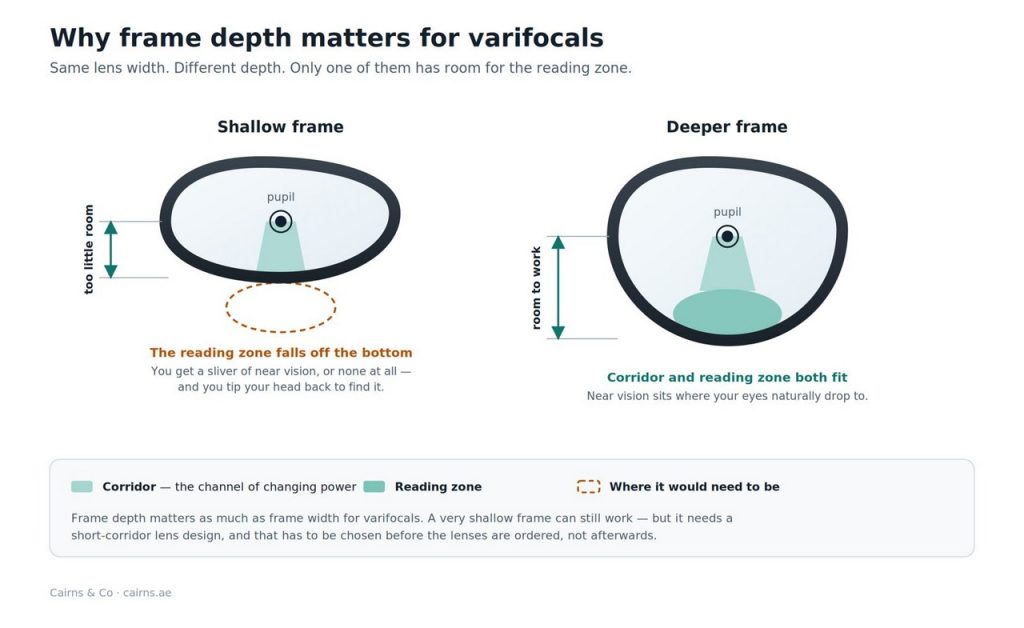
- The frame is too shallow. A corridor needs vertical room. Very small or narrow frames leave too little lens beneath the pupil, which squeezes the reading zone. Some designs are made for shallow frames, but the frame has to be chosen with that in mind.
- The reading addition jumped too far. Going straight to a strong addition is harder to adapt to than moving up in stages.
- The prescription itself has moved. Worth checking before assuming the lens design is at fault.
It is also honest to say that a small number of people never fully settle into varifocals, even with everything measured correctly. If that turns out to be you, there are good alternatives — and we would rather find that out in two weeks than have you quietly stop wearing an expensive pair of glasses.
How We Reduce the Risk Before You Order
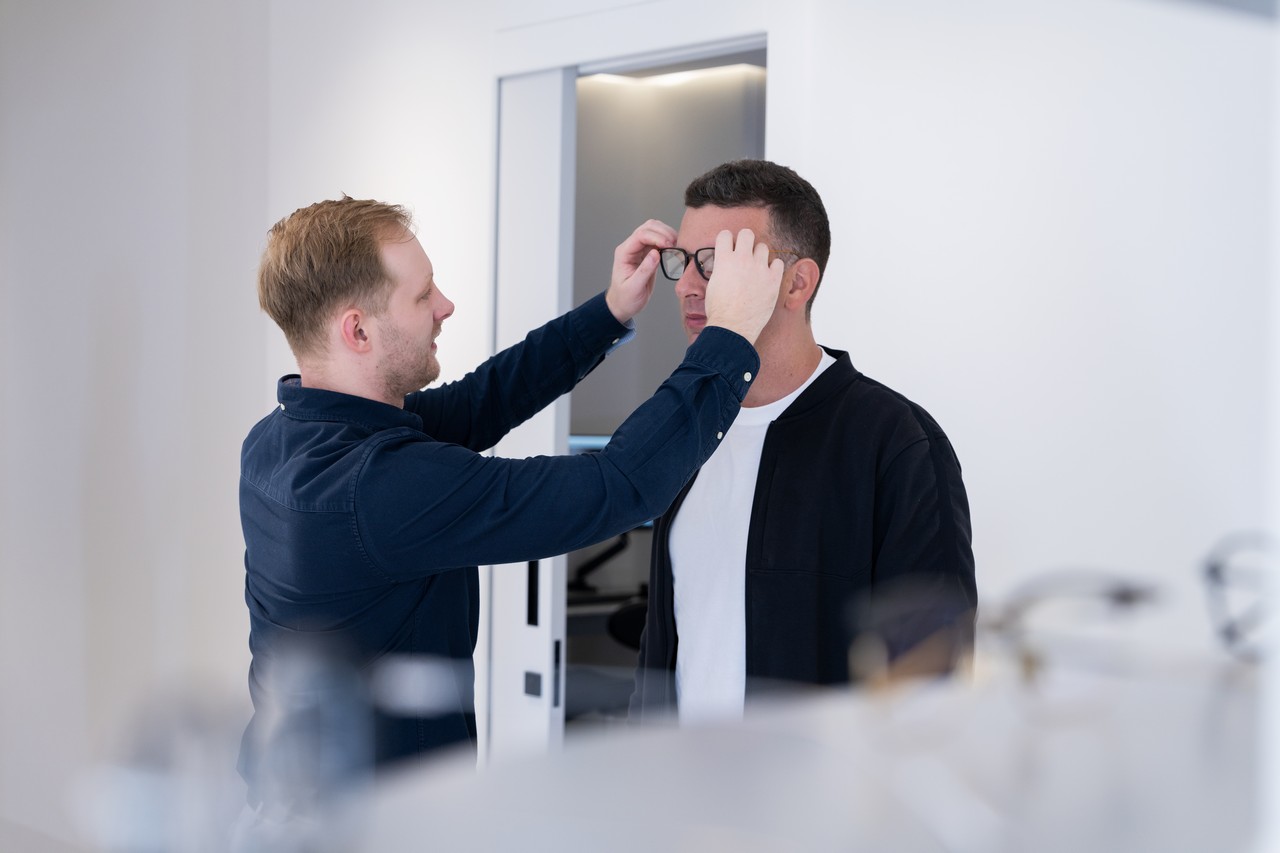
Most varifocal problems are designed in before the lens is ever made, which is why we spend time on the measurements at the point of ordering rather than troubleshooting afterwards.
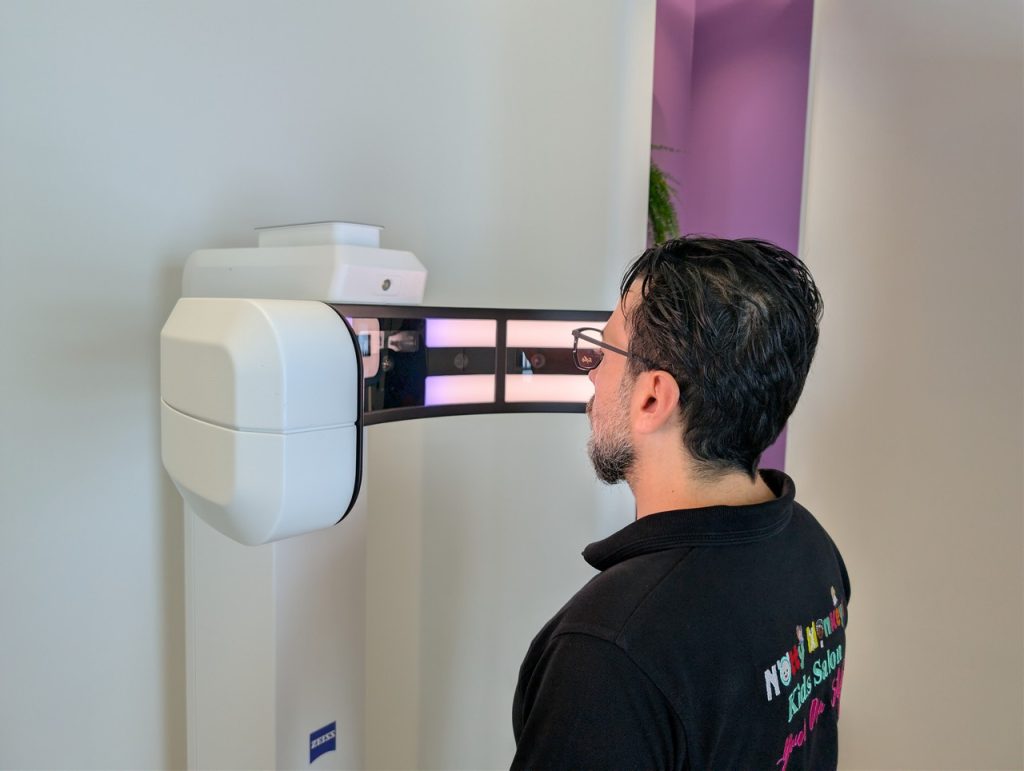
Fitting height and pupillary distance are captured on our Zeiss Visufit 1000, which photographs your face from several angles while you are wearing the frame you have chosen. It records how the frame actually sits on you, rather than how it sits against a ruler.
We also talk about frame choice before you commit to one. If you have set your heart on a shallow frame, that is workable — but it changes which lens design we order. Getting that conversation the right way round saves a remake.

Why We Fit ZEISS ClearMind
Most of our varifocals are ZEISS ClearMind, and the reason is specific to the two things this article is about: how wide the clear zones are, and how quickly people settle into them.
Traditional progressive lenses lay the corridor out to a standard geometry. ClearMind is built on what ZEISS calls NeurOptix, which designs the zones around how people actually move their eyes during ordinary tasks rather than around a theoretical model. The practical effect is that the clear areas sit where your eyes tend to go, and the blended areas are pushed further towards the edges.
ZEISS’s published figures for the design are a near zone up to 73% larger, an intermediate zone up to 45% larger, and up to 30% less blur towards the edges. There is a further tier, ClearMind Individual 3, which customises the design more closely again.
Those are manufacturer figures, and we would rather label them as such than present them as our own results.
It also pairs neatly with how we measure. The Visufit 1000 and the lens come from the same manufacturer, so the measurements feed straight into the design rather than being translated between systems.
Varifocals, Bifocals and Office Lenses
Varifocals are not the only way to deal with presbyopia, and they are not always the best one for a particular task.
| Lens type | What it does | Best for | Watch out for |
|---|---|---|---|
| Varifocal | Distance, intermediate and near in one lens, with no visible line | All-day general wear | Narrower reading and intermediate zones; needs an adaptation period |
| Bifocal | Distance and near only, with a visible dividing line | Simple near tasks; some long-term wearers prefer them | No intermediate zone, so screens are awkward; visible line; image jump at the line |
| Office or occupational | A wide intermediate and near field, with little or no distance vision | Desk work, long screen sessions and workshop benches | Not for driving or walking about |
Plenty of people end up with a pair of each — varifocals for everyday and an office lens for the desk. If you are weighing glasses against contact lenses instead, multifocal contact lenses are a further option worth discussing.
Key Takeaways
Varifocals feel strange at first because they are doing something a single lens cannot: carrying three prescriptions across one surface. The odd sensations of the first few days are the optics, not a mistake.
Give them two weeks of consistent, full-time wear. If they have not settled by then, come back — the cause is usually a measurement or a frame, and both are fixable.
Frequently Asked Questions About Varifocals
Q. How long does it take to get used to varifocals?
A. Most people adapt within one to two weeks, and many notice a clear improvement after three or four days. Wearing them full-time rather than switching back to older glasses is the biggest factor in how quickly it happens.
Q. Why are the edges of my varifocals blurry?
A. The lower outer corners of every varifocal are blended zones where the optics transition between prescriptions, and they will always look slightly soft. Better designs make them smaller and move them further out of your natural line of sight, but no lens eliminates them. Turning your head rather than your eyes keeps you out of them.
Q. Can anyone not get used to varifocals?
A. A small number of people never fully settle into them, even when everything has been measured correctly. Far more often, though, what looks like non-adaptation turns out to be a fitting height that is slightly off, a frame that has slipped, or a frame too shallow for the lens design. That is why it is worth being re-checked rather than giving up.
Q. Varifocals or bifocals, which is better?
A. Varifocals suit most people better because they include an intermediate zone for screens and have no visible line or image jump. Bifocals still have a place, particularly for wearers who have used them for years and see no reason to change.
Q. Can I drive in varifocals?
A. Yes, once you have adapted. The distance zone sits where you naturally look through the lens when driving, and the intermediate zone covers the dashboard. During the first few days, while head movements are still unfamiliar, it is sensible to keep journeys short and simple.
Q. Do I need a bigger frame for varifocals?
A. Not necessarily bigger, but deep enough. The corridor and reading zone need vertical space below your pupil. Very shallow frames can still work with a short-corridor lens design, but the frame and the lens have to be chosen together, which is why we discuss frame shape before the lenses are ordered.
If varifocals are on your mind, whether you are considering your first pair or you have a pair that never quite worked, visit Cairns & Co in Dubai or book online at cairns.ae. Our UK-trained optometrists are here to help you see clearly and comfortably.